Garden City is a professional district and a residential village sharing a name
Franklin Avenue and Seventh Street carry law offices, medical practices and banks in multi-tenant buildings. A few blocks away are brick-and-slate colonials on a planned grid. Both are in the village. Neither wants the other’s system.
Two Garden Cities, and one of them is not in the village
The Village of Garden City straddles the line between the Towns of Hempstead and North Hempstead, which already means the permit desk can change depending on which part of the village you are in. Its commercial core is the Franklin Avenue and Seventh Street professional district: multi-tenant office buildings holding law firms, accountants, medical and dental practices, banks and title companies, most of them in suites off a shared lobby and a shared elevator.
East Garden City is a different thing entirely: an unincorporated hamlet in the Town of Hempstead, not part of the village. That is where Roosevelt Field sits at 630 Old Country Road: open since 1956, now 243 stores, and also the county’s bus hub. The Old Country Road corridor around it carries office and big-box retail across into Westbury and Carle Place. If you are quoting a job at Roosevelt Field and calling it Garden City, you are in the wrong municipality.
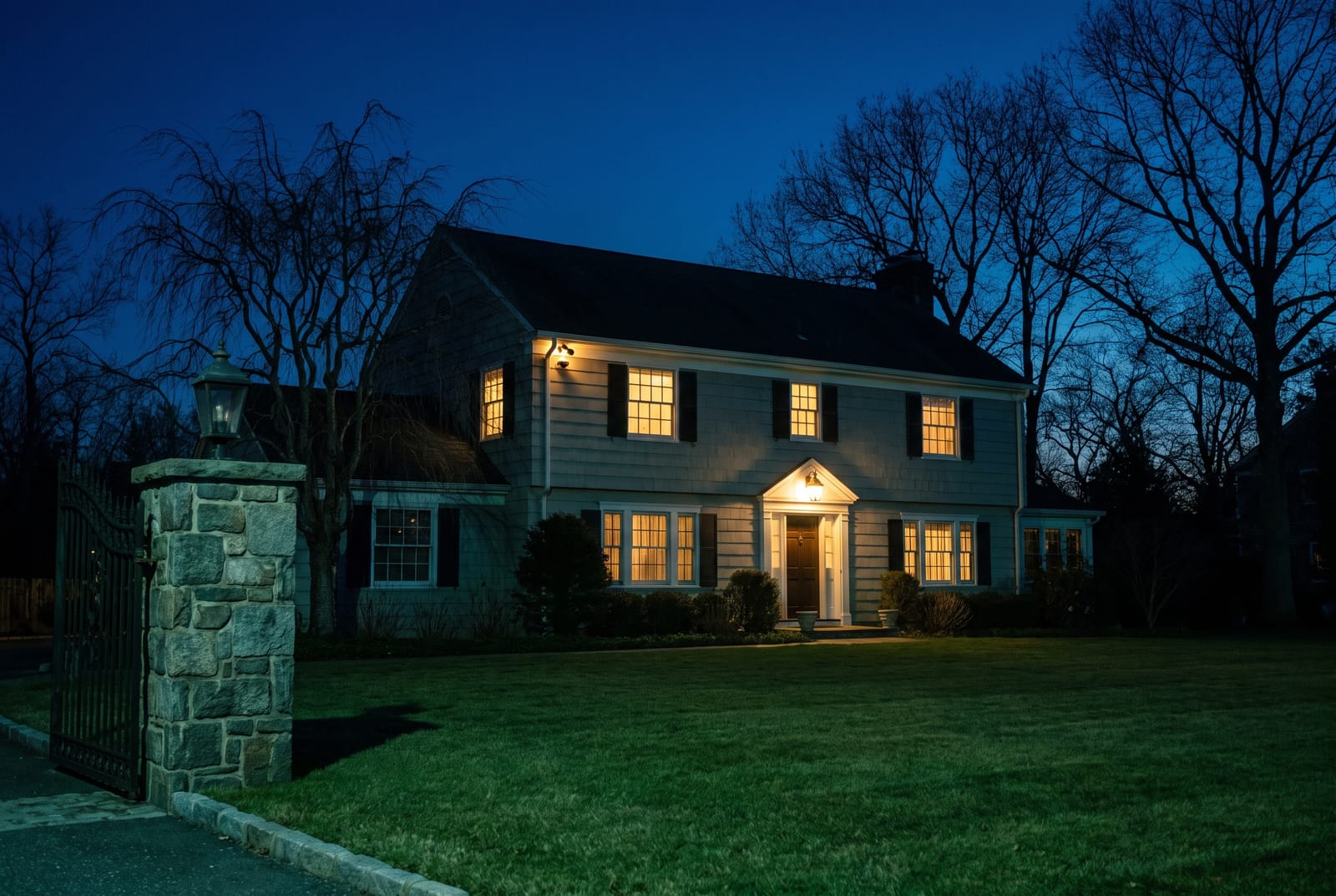
The residential village is large early-twentieth-century colonials, Tudors and center-hall houses on a planned street grid, mostly brick with slate or tile roofs, on mature tree-lined streets. Detached garages are common, driveways are short by North Shore standards, and nobody wants surface conduit on a street elevation.
What a Franklin Avenue tenant can and cannot control
The building owns the lobby, the elevator and the perimeter. You own your suite door. Most of the arguments start there.
- Your suite doors are yours; the front door is not. A tenant fit-out normally controls the suite entry, interior doors, file rooms and any dedicated back door. Perimeter, lobby, elevator and parking stay with the landlord and their credential. Check the lease before ordering anything. Most standard forms require landlord consent for door hardware changes and for penetrating a demising wall or a rated assembly.
- Decide early whether one credential can do both. If the landlord’s platform will federate with yours, staff carry one badge. If it will not, they carry two and one of them lives permanently in a coat pocket at home. Where federation is not possible, a phone credential on your side is the pragmatic answer, because nobody forgets their phone.
- Evenings and weekends are the actual requirement. Most professional tenants do not need a reader to keep people out at 2 p.m. They need to know who came in at 9 p.m. on a Sunday. That is a schedule and an audit log, and it is a very cheap thing to have if it is specified from the start rather than bolted on.
- Records rooms and cash offices are separate credential groups. A practice where every employee’s badge opens the file room has an access system, not access control. Separate groups cost nothing extra; retrofitting them after an incident costs the incident.
- Reader height is a compliance item. The 2010 ADA Standards cap unobstructed side reach at 48 inches and name card readers specifically, and door hardware on an accessible route has to be operable without tight grasping, pinching or twisting. On a suite entry with a glass door and a narrow mullion, that is worth resolving on paper before the glazier is booked.
- Your data closet is a security boundary. The recorder, the switch and the access controller belong behind a locked door with its own credential, ideally not the same one that opens the coat closet. Most small-office break-ins that defeat a camera system do it by walking out with the recorder.
Cameras that do not make a 1920s colonial look commercial
The residential job in Garden City is a restraint problem more than a technical one. Four or five cameras placed deliberately (an identification view at the front door, one at the side or mudroom door people actually use, one looking down the driveway where a vehicle moves slowly and straight, and one or two wide overviews) produce better evidence than a dozen scattered around the eaves, and cost less to record and store.
Physically: mount under soffits rather than mid-wall so the housing is shaded and the cable stays inside the structure; match housing color to the trim; keep penetrations at sills and soffits where flashing already exists; and seal and drip-loop every one of them. A poorly finished camera hole in a brick or stucco wall lets water into the cavity, and that is a far larger bill than the camera ever was.
Two traps are specific to this stock. The first is the deep front porch. On a 1920s Garden City colonial the identification camera cannot go above the door, because the porch roof puts the lens directly over the visitor’s head and hands you the crown of a hat. It goes beside the door at roughly face height, on the wall or on a porch column, looking across rather than down. The second is the sidewalk. These houses sit on a village grid with a public walk a few feet off the front step, so a loosely framed front camera records the street all day. Frame it to your own threshold and mask the walk in the recording, not merely on the live view.
Slate is the third consideration and it is a routing one. Nobody walks a hundred-year-old slate roof to get a cable somewhere convenient, so the path has to be worked out from inside the house or along the soffit line before anybody promises a camera position.
Common questions
Is Roosevelt Field in Garden City?
Not in the village. Roosevelt Field is at 630 Old Country Road in East Garden City, an unincorporated hamlet in the Town of Hempstead. The mall opened in 1956 and now runs 243 stores; the surrounding Old Country Road corridor carries office and big-box retail.
Practically this matters for two reasons. Permits and inspections go to the Town of Hempstead rather than the Village of Garden City. And a tenant fit-out inside a mall carries the landlord’s construction rules, work-hour restrictions and insurance requirements, which are usually stricter than a street-front store’s and need to be read before a schedule is promised.
Our practice keeps patient records and takes card payments. Where can we put cameras and where can we not?
Start with the places you cannot. Cameras are prohibited outright in restrooms, fitting rooms and showers under New York General Business Law §395-b, and video recording of employees in restrooms, locker rooms and changing rooms is separately prohibited under NY Labor Law §203-c. That includes the staff bathroom and it does not bend for a suspicion about one person. Then take the boundary that is specific to a Franklin Avenue or Seventh Street suite: you are one tenant in a multi-tenant building, and the corridor outside your door, the shared restroom lobby and the elevator vestibule are the landlord’s common area. A camera of yours pointed into any of them is recording the accountant’s clients and the firm upstairs. Keep your coverage inside your own demise. If the common corridor genuinely needs covering, that belongs on the building’s system after a conversation with the landlord, not on yours.
Audio has its own rule. New York is a one-party consent state, so recording a conversation you are part of is lawful, but an unattended microphone capturing a conversation between other people that you are not part of is eavesdropping under Penal Law §250.05, a class E felony. In a waiting room where patients talk to each other and to reception, that is a live risk, which is why we turn camera audio off by default and only enable it where there is a specific, defensible reason.
Where cameras do belong: the entry, the reception desk, the corridor to the records room, the door to the file room, and the exterior. What they are for is identifying who came in and when, which is also what an insurer or an attorney will ask for.
We lease a suite. What can we install without the landlord?
Assume nothing without asking. Most leases require landlord consent for changes to door hardware, for anything penetrating a demising wall or a rated assembly, and for equipment in a shared telecom closet. What tenants usually can do freely is add cameras entirely inside their own space, put a reader on a suite door where the landlord permits it, and run cabling within their own demise.
Where landlord approval is needed, it is nearly always granted if the request is specific: which door, what hardware, how it is fixed, how it fails on power loss, and confirmation that egress from the suite remains free at all times without a key or special knowledge. Vague requests get refused; drawings get approved.
Which building department covers us?
The Village of Garden City for addresses in the village, and the Town of Hempstead for East Garden City and the surrounding hamlets. The village itself straddles the Hempstead and North Hempstead town line, so if you are dealing with anything that involves the town rather than the village, confirm which town your parcel falls in before filing.
For a suite the more useful question is which approvals run in parallel. A lot of low-voltage signaling and communication work does not require a permit, and that call belongs to the department covering your address rather than to a contractor’s assumption. But in a multi-tenant professional building there are normally two other gates alongside it: the landlord’s consent for anything touching a corridor door, a rated assembly or the shared telecom closet, and an electrician for any line-voltage work, which is never ours to do. We identify all three at survey so they run together rather than one after the other, because sequentially is how a two-week job becomes a two-month one.
Can you work around our office hours?
Yes, within reason. Cabling, terminations and head-end work in an occupied suite are disruptive, so we schedule the noisy and dusty parts around your calendar and do the quiet work during the day. Doors are cut over a few at a time so nothing is ever left in a state where a door is neither on the old system nor the new one at closing time.
We work regular business hours, Sunday to Thursday, plus Friday mornings, so a full overnight cutover is not something we offer. In practice on a small professional suite that has never been necessary: a Friday morning covers most cutovers of this size.
Work that usually comes with this
Access Control Installation
Complete door-control systems, from a single door to a multi-building portfolio.
Commercial Security Cameras
Retail, restaurant, warehouse and office systems, including NDAA-compliant hardware.
Small Business & Retail
Storefronts, bodegas, salons and offices: cameras, buzz-in entry and back-of-house control.
Security Camera Installation
New IP camera systems for buildings, storefronts, offices and homes.
Structured Cabling
Cat6/6A and fibre backbones, racks, patch panels, certified and labelled.
Key Fob Entry Systems
Fob-based building entry, plus the credential management that keeps it from becoming chaos.
Suite, storefront or house?
Tell us which, and whether you own or lease. The lease is usually the thing that decides what is possible before the hardware does.
Sun to Thu 9am to 5pm · Fri 9am to 12pm · Sat closed