A camera 28 feet up will never identify anybody.
High-bay coverage tells you something happened. Identification happens at head height, at a choke point, in a narrow field of view. A yard system designed without that distinction produces thousands of hours of footage nobody can use.
Pixel density, mounting height, and the trade-off nobody states
Everything expensive about an industrial camera system comes from one physical fact: pixels spread out with distance, and height is distance.
The international standard for camera performance measures pixel density on the target: how many pixels span a person at the point where they matter. The long-standing benchmark put reliable identification of a stranger at 250 pixels per meter, and the 2025 revision of that standard raised it to 500 pixels per meter, because 250 proved insufficient once low light, motion blur and compression were accounted for. Detection (knowing something human-shaped is present) needs a small fraction of that.
Apply that to a warehouse and the design writes itself. A 4 MP camera mounted at 28 feet covering a 60-foot aisle is spreading roughly 2,560 horizontal pixels across 18 meters of scene, well inside detection territory, nowhere near identification. That camera is doing a real job: it shows movement, sequence, where a forklift went and when. It will not tell you whose face that was, and buying a higher-megapixel version of it moves the number by less than people expect while multiplying storage.
Identification comes from a second tier of cameras at head height at every choke point: the personnel door, the dock office, the corridor between the warehouse and the yard, the gate pedestrian lane. Narrow field, short distance, mounted low enough that a face crosses the frame rather than the top of a hard hat. Two or three of those do more evidentiary work than twenty high-bay cameras.
The second trade-off worth stating out loud is infrared at range. A pole-mounted camera with built-in IR lights the first twenty feet brilliantly and gives you nothing at a hundred. Yard coverage after dark is a lighting problem before it is a camera problem: white light plus true multi-exposure wide dynamic range beats IR almost everywhere outdoors, and where lighting genuinely cannot be added, the honest architecture is thermal for detection paired with a pan-tilt-zoom camera for the look, not a bigger sensor.
The findings we make on almost every dock survey
Loading docks are where the highest-value inventory sits closest to a public road, and where the least monitoring usually exists.
- No dock door position monitoring. A contact on each overhead door, reported by door number, with a shift-end exception report, turns “we think everything was closed” into a list. The most common finding in the first week is one door that stays up an hour after last shift, every shift.
- The personnel door beside the dock has no contact at all. The overhead doors get attention because they are big. The 3-foot man door beside them is how people actually come and go, and it is frequently on a mechanical lock with a key that has been copied twice.
- Cameras aimed at the door, not the threshold. A camera framed on the whole dock face shows a truck. A camera framed on one bay’s threshold at head height shows who unloaded it and what came off. If you have to choose, choose the second.
- No correlation between the door and the camera. Once the contact exists, the door-open event can bookmark the footage. That converts an eight-hour scrub into a list of twenty clips, and it is the difference between a system that gets used and one that gets ignored.
- Trailer and yard area unlit and uncovered. The dock apron is usually covered; the area where trailers are dropped rarely is. That is where seal-cutting and pilferage happen, and it is a lighting and camera-siting problem rather than an access control one.
- Cable runs pushed past the limit. Ethernet over copper is a hard 100-meter channel limit, not a guideline, not a stretch. A guard booth 400 feet out is a fiber run or a mid-span, and pretending otherwise produces a link that works in October and drops in July.
Why your truck gate stopped working, and why nobody can jumper it out
Vehicle gates are the part of this trade with the clearest liability, and the rules are specific. UL 325 requires at least two entrapment protection devices for each potential entrapment area, in each direction of travel. The operator’s own inherent force sensing counts as one; an external device (a photo eye or a contact edge) is required as the second.
The change that generates most current service calls: since 2016 those external devices are monitored. The operator watches them and, if it detects a fault or finds one disconnected, it will not run. That is why a gate stops dead when a photo eye gets dirty, misaligned, water-intruded or has its wire cut by a trailer, and it is why an installer cannot jumper out a failed eye the way the trade did fifteen years ago. When a gate company tells you the eye needs replacing before the gate will move, they are not upselling you.
The rest of the installation requirements are equally concrete and equally often missed: warning signs on both sides of the gate; controls located at least 6 feet from the gate so nobody can operate it while touching it; on a sliding gate, all openings guarded or screened from the bottom of the gate to at least 72 inches above grade; rollers guarded; contact sensors on the leading edge, the trailing edge, and post-mounted both inside and outside.
And there is a second standard that catches people: ASTM F2200 governs the gate itself: its construction, protrusions, and whether it is climbable. An operator can be perfectly compliant on a gate that is not, and the installer is expected to notice. If we survey your yard and the gate does not meet it, we will say so in writing before quoting an operator, because automating a non-compliant gate is how a maintenance problem becomes a liability problem.
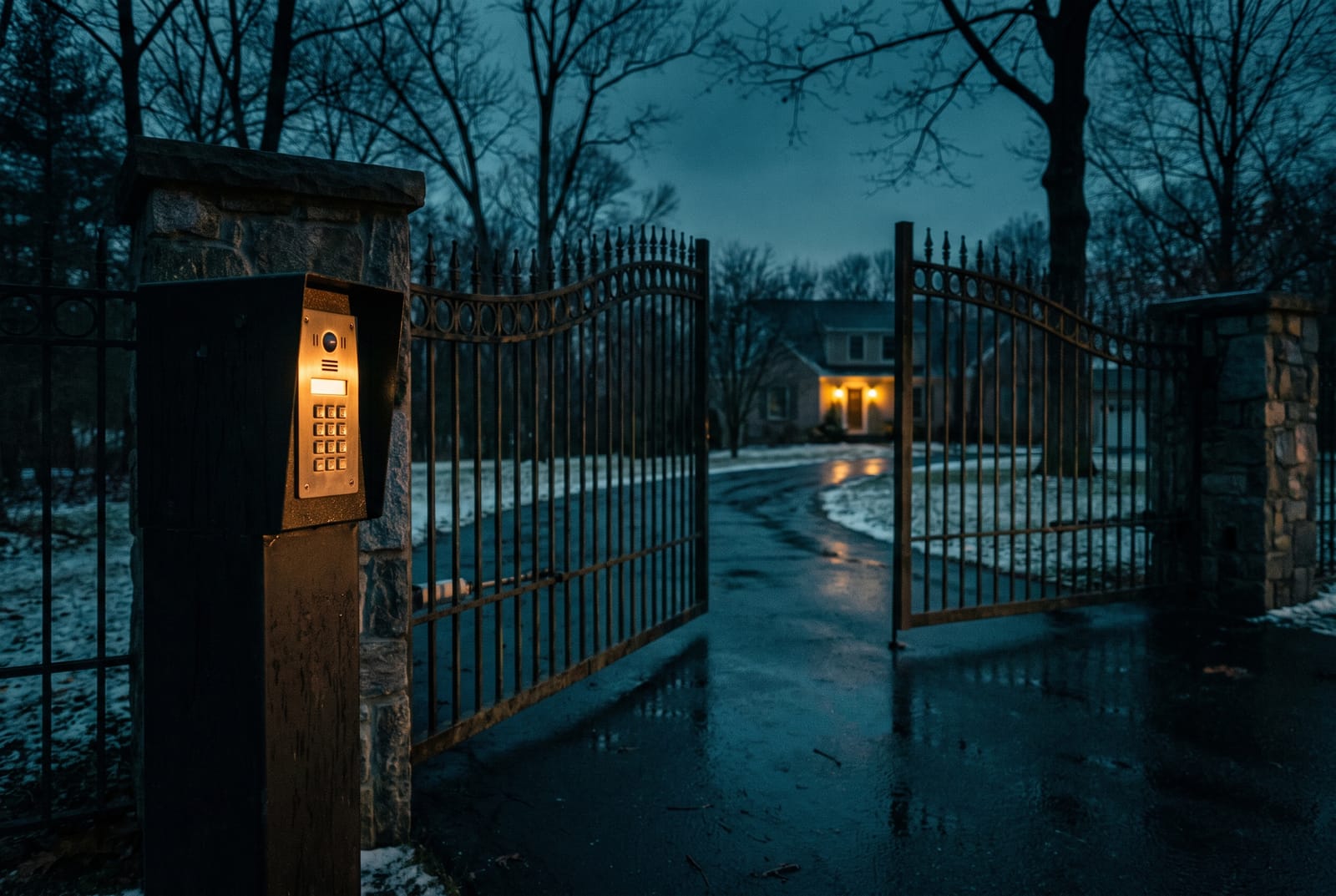
What plate reading actually requires
| Requirement | The number | Why it bites |
|---|---|---|
| Pixels across the plate | About 75 minimum; most recognition engines want 100 to 150 | This is measured on the plate, not the scene. It sets the maximum lane width one camera can cover, usually far narrower than people assume |
| Camera-to-vehicle angle | Under about 30° total, horizontal and vertical combined | A camera on the corner of the building looking across the drive at 45° will never work reliably, no matter what is spent on it |
| Shutter speed | 1/500 s as a floor, 1/1000 s typical, faster for higher speeds | Fast shutters starve the sensor of light, which is why plate cameras need dedicated illumination rather than ambient yard lighting |
| Illumination | Infrared at 850 or 940 nm, mounted close to the lens axis and above headlight height | Plates are retroreflective, so IR lights them up while leaving the driver unblinded. Expect IR reach to fall by roughly half at the shutter speeds plate work demands |
| Frame rate | 25 to 30 fps above roughly 35 mph | You want several blur-free attempts per pass, not one lucky frame |
| Camera resolution | Keep on-camera recognition at 2 MP or below | Higher resolution slows the on-board processing and delays the read. This is the counter-intuitive one that catches buyers used to more-is-better |
Two different products get sold under one acronym. Plate capture gives a human a readable image for later. Plate recognition produces a text string a system can match against a list and act on. The second one needs every row below to be true.
If you hold or bid on any federal work, the camera brand is a compliance question
NDAA FY2019 §889 names Huawei, ZTE, Hytera, Hikvision and Dahua, along with their subsidiaries and affiliates, as covered telecommunications and video surveillance equipment. The same companies appear on the FCC Covered List. The prohibition that catches industrial operators is the second one: from August 2020, a federal agency may not contract with an entity that uses covered equipment in its own operations, whether or not that use has anything to do with the federal work. A covered camera on your own warehouse can therefore be a problem for a contract that has nothing to do with cameras.
The trap underneath it is rebadging. A large volume of surveillance hardware sold under other brand names is manufactured by covered entities, so a product that looks unrelated can still be covered. That is why we will not make a blanket compliance claim about a catalog: the verification is per model, per chipset lineage, and a false claim to a federally funded buyer is a much bigger problem than a marketing one.
What we will do is tell you honestly what is in your existing system, and specify from manufacturer families that are not on the list where compliance is a requirement of your business.
Common questions
We have twenty cameras and we still cannot identify anyone. What went wrong?
Almost certainly that every camera is doing the same job. Twenty wide overhead views give you twenty versions of the same detection-grade footage (movement, direction, timing) and no identification anywhere, because identification is a function of how many pixels land on a face, and a wide view at height spreads them too thin.
The fix is rarely to replace the twenty. It is to add two or three tight cameras at head height at the points every person must pass through: the personnel door, the dock office door, the gate pedestrian lane. Those become your identification tier; the existing cameras stay as your context tier and you now have a system where one answers “who” and the other answers “what happened next”.
A survey should give you a plan drawing with each camera labeled by what it is expected to deliver at its mounting position: detection, observation or identification. If the proposal you are holding does not have that, it was sized by camera count.
Our gate stopped working and the company says the safety eye is bad. Is that real?
Yes, and it is not a discretionary repair. Since 2016 gate operators are required to monitor their external entrapment protection devices. If the operator detects a fault in a photo eye or a contact edge, or finds one disconnected, it stops running by design. The gate is not broken; it is refusing to move because it can no longer prove it will not close on someone.
Common causes are mundane: a lens fouled with road film or spider webs, a bracket knocked out of alignment by a trailer, water in a connector, or a cable cut by yard traffic. Those are cheap. What is not acceptable is a repair that defeats the device, and any contractor offering to bypass it is offering to take on your liability and hand it back to you.
While the technician is there, it is worth having the whole arrangement checked against the requirements: two entrapment devices per area per direction, signage on both sides, controls at least six feet from the gate, sliding gate openings screened to 72 inches. Most yards we survey are missing at least one of those.
Can plate reading work at our yard entrance at night?
It can, but only if it is engineered as a plate camera rather than a general camera pointed at a driveway. That means a dedicated infrared illuminator mounted close to the lens axis and above headlight height, a shutter fast enough to freeze the vehicle, a camera-to-vehicle angle under roughly 30 degrees, and enough pixels across the plate itself, typically 100 to 150 for a recognition engine.
The night-specific point most buyers do not hear: license plates are retroreflective, which is why infrared works so well on them, and why a plate camera at night can produce a crisp plate on an otherwise black frame. That is normal and correct. If you also want to see the driver and the vehicle color at night, that is a second camera with white light, not the same one.
Also worth deciding early which product you actually need. If the goal is a gate that opens for known vehicles, you need recognition and everything above. If the goal is a readable image to hand to police after an incident, plate capture is a cheaper and more forgiving build.
How much storage do 24 cameras actually need?
Use the arithmetic rather than a vendor’s table. One megabit per second of recorded video is about 10.8 GB per day. A 4 MP camera on modern compression at 15 frames per second sits around 3 Mbps, so 24 of them recording continuously for 30 days comes to roughly 23 TB of usable storage. Usable is after redundancy, so budget meaningfully more raw capacity than that.
The lever that saves the most money is tiered retention rather than cheaper drives. Keep 90 days on the gate, the dock thresholds and the cash or high-value areas; keep 30 days on general floor coverage. That typically removes 30 to 40 percent of system-wide storage while improving the retention you actually care about, and it is the single most persuasive line in a competitive bid.
One thing not to economize on: drives. A desktop hard drive in a recorder writing 24 streams continuously will fail early and take the array with it. Surveillance-rated drives are designed for that duty cycle, and they are a small fraction of the system cost.
Can we get a network connection to the guard booth 400 feet from the building?
Not on a copper Ethernet run. The channel limit is 100 meters, about 328 feet, and that includes patch cords at both ends. A 400-foot run will sometimes appear to work on a bench and then produce intermittent faults under load, in heat, or once power over Ethernet is drawing current through it, which is the worst kind of failure to diagnose.
The correct answers are fiber to a small switch at the booth, or an outdoor-rated media converter arrangement, or a properly engineered point-to-point wireless link where trenching is impossible. Fiber is usually the right call in a yard because it is immune to the surge and ground-potential problems that plague long copper runs between separate structures. A lightning-induced surge coming down a copper run between two buildings will take out equipment at both ends.
If the trench is the obstacle, say so early. Sometimes the cheapest path is a conduit route that already exists for something else, and that is a survey finding rather than a design assumption.
We run three shifts. When can you actually do the work?
We work regular business hours, Sunday to Thursday, plus Friday mornings, and on a three-shift operation that usually means working alongside production rather than after it. That is normally fine for cable, mounting and gate work if we know the traffic pattern. What we need from you is which aisles and dock doors are hot at which hours, and a point of contact who can stop a forklift lane for twenty minutes.
What we plan carefully is the cutover on anything that controls a door. Doors go one at a time, with the existing arrangement working until the new one is tested, so a shift change never arrives at a door that does neither. Where a job genuinely has to happen outside operating hours, we schedule it as planned evening or off-shift work and price it that way in the written scope, rather than treating it as an emergency.
Work that usually comes with this
Commercial Security Cameras
Retail, restaurant, warehouse and office systems, including NDAA-compliant hardware.
Gate & Parking Access Control
Vehicle gates, garage doors, parking control and the loops and safeties that go with them.
Access Control Installation
Complete door-control systems, from a single door to a multi-building portfolio.
Structured Cabling
Cat6/6A and fibre backbones, racks, patch panels, certified and labelled.
Security Camera Installation
New IP camera systems for buildings, storefronts, offices and homes.
Property Management
Portfolio work: one vendor, consistent hardware, COIs on file, documented every time.
Send a site plan and a dock count.
Number of dock doors, yard dimensions, gate type and whether trucks arrive after dark. That’s enough for us to tell you where the cameras belong and what each one will actually deliver.
Sun to Thu 9am to 5pm · Fri 9am to 12pm · Sat closed