A lockdown device that blocks egress is illegal, not just risky.
Most of what gets sold to schools as lockdown hardware would fail a fire inspection, and some of it would trap children in a room. The compliant version exists, costs about the same, and almost nobody explains the difference.
What makes a vestibule a vestibule
The word gets used for anything with two doors. A controlled vestibule is a specific geometry, and half the buildings that want one cannot have one without construction.
A functioning controlled vestibule has four parts: an outer door that is unlocked or remotely released, a fully enclosed space behind it, an inner door that is locked and can only be released from the office, and a way for the office to see and speak to whoever is standing between them. Remove any one of those and it is a lobby, not a vestibule.
The reason this matters commercially is that many older New York school buildings have an outer door that opens directly into a corridor with the office off to one side. Creating a real vestibule there means building a partition and a second door line: a construction job with an architect, a filing and a general contractor, with our work as one trade inside it. We will tell you that on the survey rather than quoting an intercom and letting you discover the geometry problem in September.
Where the geometry does exist, the electronics are straightforward and the details are where it succeeds or fails. The camera at the outer door should be at head height and framed tight enough to identify a face, not mounted above the door looking down at hats. The intercom should be reachable by a person using a wheelchair: operable parts between 15 and 48 inches above the floor, per the reach range in the 2010 ADA Standards, which expressly names card readers and keypads among the elements affected when that maximum came down from 54 inches. And the release control belongs where the office staff actually sit, with a second one wherever a single person covers the desk alone.
The last piece is the part everybody skips: a door position switch on every exterior door in the building, with a held-open alarm to the office. Visitor screening at the front entrance is worth very little if the gym side door is propped every afternoon for deliveries. That propped door, not the front entrance, is how people actually walk into schools.
Barricade devices: the direct answer
Classroom barricade devices (floor plates, door jammers, straps, sleeves that drop over a closer arm) are widely marketed to schools and most of them conflict with basic egress requirements. An exit door has to be openable from the inside in a single motion, without a key, a tool, special knowledge or effort, and door hardware in an accessible route must be operable without tight grasping, pinching or twisting of the wrist under 2010 ADA Standards §404.2.7 and §309.4. A device that must be located, lifted, aligned and removed before the door will open fails all of that.
There is a second problem people raise less often: a barricade prevents entry by anyone, including staff with a master key, a school safety agent and the fire department. A device installed to keep an attacker out also keeps out the person coming to help, and in a medical emergency inside that room it is a serious hazard.
The compliant answer is a classroom security lockset: a lever set that can be locked from inside the classroom without opening the door, that always allows free egress from inside, and that a master key or credential still opens from the corridor. It solves the actual problem (a teacher should not have to step into a hallway to lock a door) without creating a trap.
The four locking arrangements a school can legally use, and their conditions
Every one of these is permitted. What varies is what has to be true first, and a proposal that omits the conditions is quoting a violation.
- Fail-secure electric strikes on non-egress doors. Power off means locked. Required on fire-rated assemblies, because a fire door has to stay positively latched to contain smoke. Free egress is preserved mechanically by the lever or panic bar on the inside: the strike controls entry only.
- Door hardware release on an electrically locked egress door. The release switch lives inside the lever or the panic bar, so pushing the bar directly interrupts lock power. Fewer ancillary devices than the sensor version, which is why it is usually the cleaner design, and where panic hardware is required its operation must release the lock.
- Sensor release of an electrically locked egress door (the maglock path). Permitted, but only with all of: a sensor on the egress side that unlocks on approach; automatic unlock on loss of power to either the sensor or the lock; a manual button 40 to 48 inches above the floor, within 5 feet of the door, signed PUSH TO EXIT, that directly interrupts lock power and keeps the door unlocked at least 30 seconds; unlock on fire alarm, sprinkler or detection activation, staying unlocked until the system is reset; emergency lighting on the egress side; and a locking system listed to UL 294. That is the full list. Anyone quoting a maglock without it is quoting something you will fail an inspection on.
- Classroom security locksets. Locked from inside without opening the door, free egress from inside at all times, corridor side still openable with a key or credential. The correct answer for classroom lockdown, and the one that survives both a fire inspection and a medical emergency.
- Delayed egress is not available to you. The model code does not permit delayed-egress locking in Educational occupancies, and everywhere it is permitted it requires sprinklers or approved detection throughout the building. If a vendor proposes a fifteen-second delay on a school exit, that alone tells you what their code knowledge is worth.
The relay that has to drop, and the one that must not
Every electrically locked door in an exit path must release when the fire alarm goes into alarm. That is not negotiable and it is verified by physically activating the alarm and watching each door release, a test that should be done at commissioning and repeated annually.
The detail that gets designed wrong is which outputs drop. An access control power supply has individually selectable outputs specifically so that the maglocks on the stair doors release while the fail-secure strikes on the fire-rated doors stay locked. Reverse that selection and you have both a code violation and a security hole in the same cabinet: fire doors that unlatch and lose their rating, and stair doors that stay held during an evacuation.
We do not touch the fire alarm control panel. Fire alarm installation, inspection, testing and service in New York City requires an FDNY-recognized company and certified technicians, and that is a separate trade. What we do is specify the interface (a dry contact from their panel to our power supply), write it into the scope so your business office can see who is doing what, and be present with their technician when it is tested so there is no argument about whose device did not respond.
The related item worth budgeting for: standby batteries. Access power supplies shed their outputs when battery voltage falls below roughly three quarters of nominal, which presents as doors behaving strangely for weeks before anything visibly fails. In a school that shows up as a door that sometimes will not release for a credential, which staff work around, which is how doors end up propped.
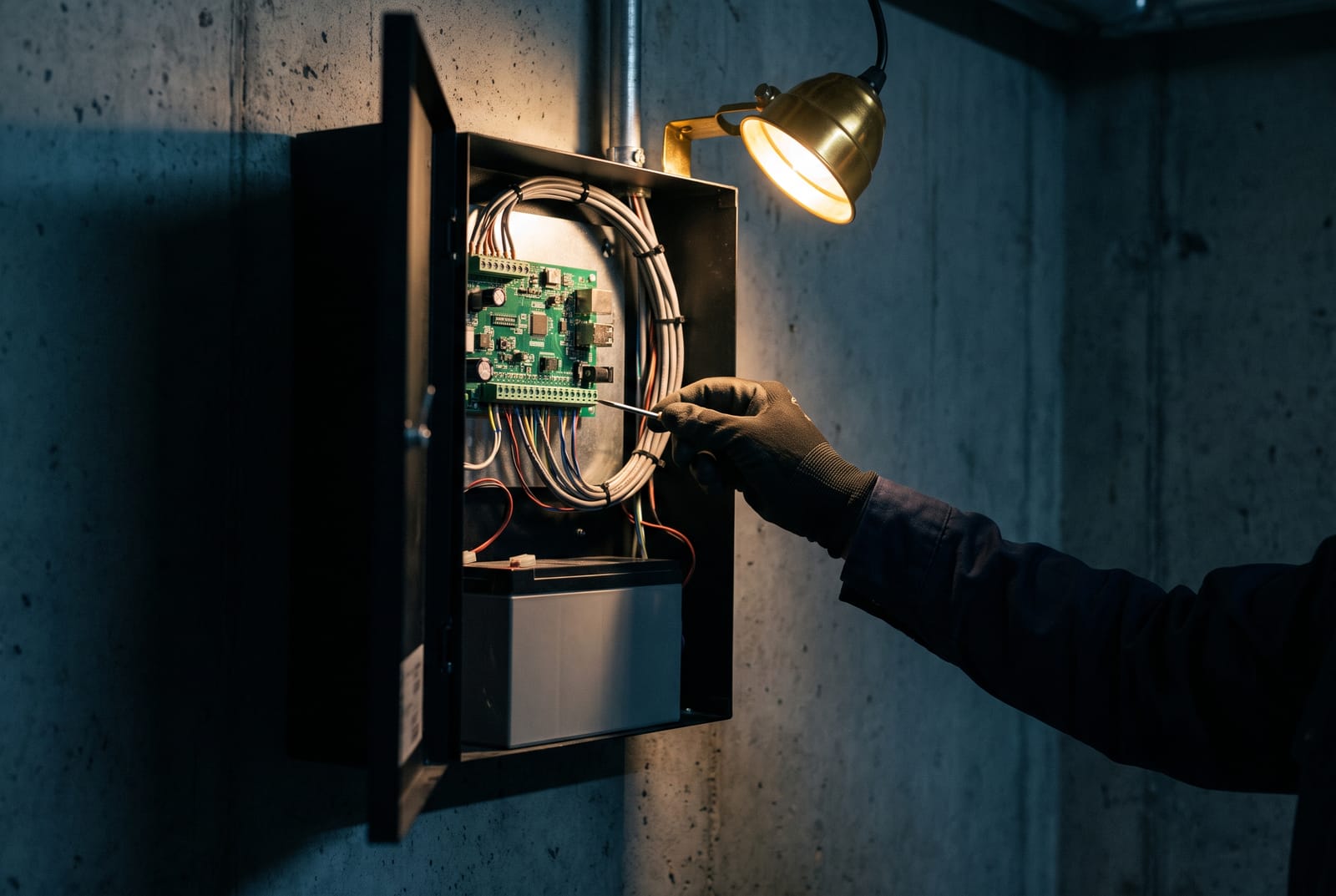
Where cameras belong in a school building, and where they are prohibited
| Location | Position | Basis |
|---|---|---|
| Main entrance, exterior and interior | Yes: head height, tight framing, identification grade | The one camera in the building most likely to matter |
| Every exterior door | Yes: paired with a door position switch and a held-open alarm | Propped side doors are the actual vulnerability, and a camera without a contact tells you nothing until you already know when to look |
| Corridors and stairwell landings | Yes: context grade, wide | Movement and sequence. These do not need to identify anyone |
| Cafeteria, gym, auditorium, playground | Yes | High-incident areas. Playground coverage should be framed on gates and the perimeter, not on faces |
| Restrooms and locker rooms | Never inside: cover the corridor approach only | New York GBL §395-b prohibits devices observing the interior of restrooms and similar spaces; Labor Law §203-c separately prohibits recording employees in restrooms, locker rooms and changing rooms |
| Classrooms | Generally no, and it is a policy decision rather than a technical one | There is no code prohibition, but it is a governance question for your board and your community, and we would rather it be decided deliberately than by where a cable happened to reach |
| Nurse’s office, counseling rooms | No | Health and counseling privacy. Cover the approach corridor instead |
The prohibitions below are statutory. The recommendations are ours. Camera audio is disabled by default on every system we install.
Grant money, fiscal years, and the brand question that comes with them
Schools and daycares almost never buy on the timeline the survey suggests. The money is attached to a fiscal year that started in July, or to a grant with its own cycle, and the purchase order arrives months after the decision. What that means practically is that the survey and the written scope have to exist long before the funds do, and that a scope written for a specific quarter will be stale by the time it is executed. We write school scopes with the pricing basis and the assumptions stated, so when it is picked up two quarters later, everyone can see what has to be revisited.
It also means the scope should be structured to be cut. A school proposal that is a single number cannot survive a budget reduction; one that is phased (entrance and exterior doors first, interior door control second, camera expansion third) can absorb one without becoming a different project.
The brand question follows the money. If any part of the purchase involves federal funds, the restriction under NDAA FY2019 §889 and the FCC Covered List is relevant: Huawei, ZTE, Hytera, Hikvision and Dahua equipment, along with equipment from their subsidiaries and affiliates, is covered, and federal award conditions routinely flow that restriction down to the recipient. The complication is that a large volume of surveillance hardware sold under unrelated brand names is manufactured by covered entities, so the check has to be per model rather than per brand. We will not make a blanket claim about a whole catalog, and neither should anyone else quoting you; what we will do is verify the specific models we propose and tell you what is already in your building.
One more thing about daycares specifically: parent pickup authorization changes, sometimes urgently and sometimes because of a custody order. A system where the director can revoke a credential and update the authorized-pickup list from a browser in a minute is not a convenience feature in that context. It is the requirement.
Common questions
A vendor sold our school barricade devices for classroom doors. Should we use them?
Our answer is no, and we will not install them. An exit door must open from the inside in one motion without a key, tool or special knowledge, and door hardware on an accessible route has to be operable without tight grasping, pinching or twisting. A device that has to be found, positioned and removed before a door will open does not meet either requirement, and a room full of children is exactly the wrong place to discover that.
The second objection is one that fire officials raise consistently: a barricade excludes everyone, including staff with a master key, responders and anyone coming to help with a medical emergency inside that room. The device is designed for one scenario and creates a hazard in several more common ones.
The compliant alternative is a classroom security lockset: lockable from inside the room without stepping into the corridor, always free to exit from inside, still openable from the corridor with a key or credential. That is the actual problem those devices were sold to solve, solved in a way that passes inspection.
We want the main entrance on a magnetic lock. What does that actually involve?
More than the lock. Sensor release of an electrically locked egress door is permitted, but the code package that comes with it is specific: a sensor on the egress side that unlocks the door as someone approaches; automatic unlock on loss of power to either the sensor or the lock; a manual button mounted 40 to 48 inches above the floor within five feet of the door, signed PUSH TO EXIT, that directly interrupts power to the lock independent of everything else and keeps it unlocked for at least 30 seconds; unlock on fire alarm, sprinkler and detection activation, remaining unlocked until the system is manually reset; emergency lighting on the egress side; and a locking system listed to UL 294.
All of it, not a selection. If a proposal quotes a maglock, a reader and a power supply without those items, the number is not comparable to a compliant one, and the difference will show up at inspection.
There is often a better route worth considering first. If the door has or can take a panic bar or lever with an integrated release switch, the hardware-release arrangement achieves the same control with fewer ancillary devices and fewer things to go wrong. It is usually the design we recommend on a school main entrance.
Can we put cameras in the hallway outside the bathrooms?
Yes, and it is normally a good idea. The corridor approach is where the incidents that matter tend to start. What you cannot do is have a device observing the interior of a restroom, and you should be careful that a wide-angle camera in a corridor is not seeing through an open door into one. That is a framing check at commissioning, not an assumption.
Separately, no video recording of employees in restrooms, locker rooms or rooms designated for changing clothes. In a school that includes staff bathrooms and the gym staff office if it doubles as a changing room, which is a detail worth confirming rather than guessing.
Where a camera’s field unavoidably includes a doorway you would rather it did not, privacy masking (a fixed blanked region in the image) is a legitimate tool, and we set it at commissioning and document it in the handover so a later administrator knows it is there and why.
We are a daycare operating inside an apartment building. Does that change things?
Substantially, because you have a landlord and possibly a board between you and the front door. Your entrance is likely also the building’s residential entrance or adjacent to it, which means anything you install on it is subject to the building’s approval, and any credential system has to be partitioned so your staff cannot admit anyone to residential common areas and residents cannot enter your space.
Practically, the workable pattern is a system that is yours inside your demised space (your inner door, your camera, your credentials), plus an intercom arrangement at the building entrance agreed with the landlord. Trying to control the building’s front door for daycare purposes is where these projects get stuck.
Two more considerations specific to this setup. The building’s house rules will govern when noisy work can happen, which usually means the install cannot happen during your operating hours or during the building’s quiet hours, a narrow window that needs planning. And the pickup authorization list is the part of your system that changes most often, so it must be administrable by your director without a service call.
Can you tie our lockdown button into the fire alarm?
Not directly, and you should be wary of anyone who says yes casually. We do not connect to the fire alarm control panel (that is FDNY-regulated work requiring a recognized company and certified technicians in New York City), and combining lockdown signaling with fire alarm signaling is conceptually risky, because the two events require opposite door behavior. Fire alarm unlocks egress doors. A lockdown locks interior doors. Wiring them together is how you end up with a system that does the wrong thing under stress.
What we do build is a lockdown function inside the access control system: one action (a button, a keyfob, a phone) that locks the interior door groups you have defined, while every exit path continues to allow free egress from inside, and while the fire alarm interface remains untouched and still releases what it must. The two systems stay independent, which is the point.
We also recommend the state your lockdown reverts to be explicit and documented: what happens if the network drops mid-lockdown, who can clear it, and how a responder gets in. Those answers belong in your emergency plan and in the handover document, not in someone’s memory.
We are buying with grant money. Does the equipment brand matter?
If federal money is involved, yes. Huawei, ZTE, Hytera, Hikvision and Dahua, along with their subsidiaries and affiliates, are covered telecommunications and video surveillance equipment under NDAA FY2019 §889 and appear on the FCC Covered List, and federal award conditions commonly flow that restriction down to recipients.
The part that catches buyers is rebadging: a great deal of surveillance hardware is sold under brand names with no obvious connection to a covered manufacturer but built on their platforms. That means the compliance check is per model, not per brand, and it means we will not put a blanket “all our products comply” line in a proposal. A false claim to a federally funded buyer is a much larger problem than a marketing overstatement.
What we will do is name the specific models proposed, verify them, and tell you what is currently installed in your building, which for a school that has bought cameras over several budget cycles is often a mixed picture worth knowing about before the next audit.
Work that usually comes with this
Access Control Installation
Complete door-control systems, from a single door to a multi-building portfolio.
Security Camera Installation
New IP camera systems for buildings, storefronts, offices and homes.
Intercom Installation
New audio or video entry systems, wired or IP, sized to the building.
Mobile & Cloud Access Control
Phone-as-credential systems with browser-based administration and remote unlock.
Houses of Worship
Perimeter cameras, controlled entry, and systems that fit NSGP grant scopes.
Commercial Security Cameras
Retail, restaurant, warehouse and office systems, including NDAA-compliant hardware.
Get the survey done before the budget cycle, not after.
Tell us the building, the number of exterior doors and whether the main entrance has a real vestibule. We’ll write a phased scope your business office can actually use.
Sun to Thu 9am to 5pm · Fri 9am to 12pm · Sat closed